


Claudia Ho Lem, Intern 2001-2002
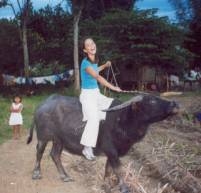
Background Bio:
Growing up with a strong environmental ethic, I was drawn to pursue a Bachelors Degree in Environmental Science at the University of Calgary. Through my 3 years of work as an environmental consultant, interest in nature and membership in various ecological conservation initiatives, I became deeply involved in many Canadian environmental issues. I continued to search for ways to make a positive contribution to solving environmental issues and working directly with the people living in affected areas, eventually being placed as a REAP-Canada intern in the Philippines in 2001.Education:
B.Sc. (Environmental Science), University of Calgary,specialization in Biology, minor in Chemistry
Host Country:
the PhilippinesInternship Experience:
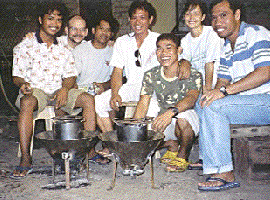
During my 6 months in the Philippines, I was directly involved in the development of our Agro-Ecological Village and Climate Change Projects. I assisted in implementing participatory ecological trainings and assessing adaptability trials (examining localized ecological farming practices, farm diversification, farmer breeding programs, ecological sugar cane and eco-rice). Working with skilled participatory development practitioners, I also assisted in capacity building in the communities, helping with local gender initiatives, PRA's and other participatory development approaches. During my internship I was also involved in one of REAP's most important accomplishments, the initial research and development of the Mayon Turbo Stove (MTS) and its local production and distribution, the program eventually supplying 5000 stoves! Working with Roger Samson and the local engineers, we developed an improved version of the MTS that was incredibly clean burning and low in cost, leading to improved health for local women and a substantial reduction in the cost of household expenses. Finally, I was involved in our climate change efforts, assisting in Greenhouse Gas accounting for the MTS, and pioneering research on the GHG mitigation potential of ecological sugar cane production, our project eventually mitigating 4240 tonnes of CO2e during the year 2001!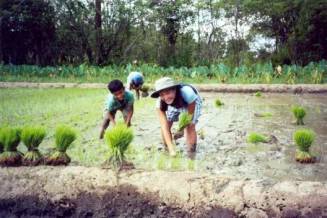 In
addition to working side-by-side with local counterparts, my cultural
integration gave me a special perspective of what rural life in the Philippines
was like. During this 2-week period and almost every week afterwards
I had the chance to stay on a farm with a family and live in their bamboo
hut on the side of a mountain. From the first moment I arrived I was
welcomed as one of the family and lived as they lived. I learned about
growing sugarcane, digging for camote, riding and feeding carabao's,
plowing with animal traction and how to cultivate wonderful organic rice!
I soon started to understand all of the limitations in a cash crop monoculture
system, arduous field labor in the tropical heat, an average farm
size of only 2 hectares, a very limited and basic diet and no access
medical care because of its prohibitive cost. But I also found that the
farmers possessed an enormous family bond and sense of resilience. With
their own initiatives they united and formed community organizations
to confront their difficult situation collectively.
In
addition to working side-by-side with local counterparts, my cultural
integration gave me a special perspective of what rural life in the Philippines
was like. During this 2-week period and almost every week afterwards
I had the chance to stay on a farm with a family and live in their bamboo
hut on the side of a mountain. From the first moment I arrived I was
welcomed as one of the family and lived as they lived. I learned about
growing sugarcane, digging for camote, riding and feeding carabao's,
plowing with animal traction and how to cultivate wonderful organic rice!
I soon started to understand all of the limitations in a cash crop monoculture
system, arduous field labor in the tropical heat, an average farm
size of only 2 hectares, a very limited and basic diet and no access
medical care because of its prohibitive cost. But I also found that the
farmers possessed an enormous family bond and sense of resilience. With
their own initiatives they united and formed community organizations
to confront their difficult situation collectively.
 My
internship experience with REAP-Canada gave me the background to understand
why a participatory grassroots approach is the key to sustainable development.
From our projects, I recognized that education and skill building is
the beginning of empowerment for rural communities. The practical application
of knowledge is also critical, which is why the learning farm approach,
combining cross-site visits and on-farm research done by the farmers
themselves, is so effective. The internship also confirmed for me the
importance of addressing a problem in its entirety and deriving holistic
long-term solutions together with the people being affected, be it on
the scale of a country, city, community, remote rural village or within
a single household.
My
internship experience with REAP-Canada gave me the background to understand
why a participatory grassroots approach is the key to sustainable development.
From our projects, I recognized that education and skill building is
the beginning of empowerment for rural communities. The practical application
of knowledge is also critical, which is why the learning farm approach,
combining cross-site visits and on-farm research done by the farmers
themselves, is so effective. The internship also confirmed for me the
importance of addressing a problem in its entirety and deriving holistic
long-term solutions together with the people being affected, be it on
the scale of a country, city, community, remote rural village or within
a single household.
Alejandro de Maio Sukic, Intern 2001-2002
Background Bio:
Despite my keen interest in nature and wildlife, I started my professional career in accounting. I became an accountant in 1994 and worked as such for about 4 years. Then I found my way into environmental economics, in which I completed a master's degree in McGill University.Education:
M.A. (Environmental Economics), McGill UniversityHost Country:
the PhilippinesInternship Experience:
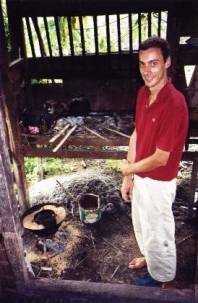
During my time in the Philippines I provided accounting and economic support to the local partners, mainly to the Mayon Turbo Rice Hull Stove project. I gave a hand to local staff with the accounting system for reporting back to CIDA on the on-going projects. This may not sound like the most exciting part of a project but it plays an important role in the communication between partners in Canada and the Philippines, which helps in establishing good working relationships.Unfortunately, economists' work is quite abstract and doesn't lend itself easily to hands-on tasks and field labour. My experience working in the sugar cane fields helped me to quickly learn about the value of traditional herbal medicine knowledge. But my most memorable endeavour was a study of the potential savings in energy and money to rural households in Negros using the rice stove. I prepared a survey with the help of local farmers, which was actually carried out by the stove marketing team. Then I did some traveling to gather local prices of cooking fuels. My surprise at the hand of affable and enthusiastic local people did never end, they met me everywhere while I was on the road. I finished my study in Canada, and found that the rice stove had the potential for assisting farmers in improving their finances while using local renewable fuels, instead of relying on imported or overly harvested fuels. This showed me the foundation of a sustainable local community, where local people diversify their skills and use their environment and resources in smart ways.

