


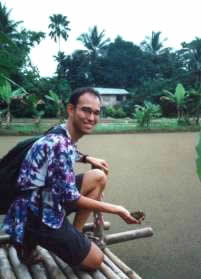
Trevor Helwig, Intern 2000-2001
Background Bio:
With a bachelor's degree in agricultural engineering, I gained work experience working for a design firm conducting computer modeling of municipal sewer and water systems. I then decided to complete my master's degree after which I found out about the REAP-Canada internship position.Education:
B.Sc. (Agricultural Engineering), McGill UniversityM.Sc. (Applied, Environmental Engineering), McGill University
Host Country:
the PhilippinesInternship Experience:
My work in the Philippines focused on developing a project with a farmer's alliance that involved the conservation of sugarcane residue known as 'trash farming', as well as the building and marketing of stoves that used rice hulls as fuel in a stove design developed in Vietnam. The aim of the sugarcane component of the project was to improve soil fertility by working the cane residues into the soil, as opposed to the conventional practice of burning the trash. The stove component of the project aimed to displace household cooking fuels such as coal and firewood. The overall goal of the project was to reduce greenhouse gas emissions associated with the burning of the rice hulls, sugarcane residue, coal, firewood and other displaced cooking fuels.Initially, I investigated that the rice hull stove design and made sure that the fabrication of the stove was possible. As well, Lindsey Mulkins (the other Canadian intern) and I were involved in the development of the proposal and report writing to the funding agency (CIDA). Other activities involved networking with other organizations and investigating other appropriate technologies (small scale tools for farming, including rotary weeders for rice paddies, harrows, alternative pumping technologies, biogas systems etc.).
After finishing my internship in the Philippines I continued to work on REAP-Canada's programming in Ste. Anne de Bellevue, Quebec. I completed a study with REAP-Canada's then-director (Rupert Jannasch) that examined biomass inventories in Eastern Canada as a source for bioenergy, as well as helping with the development of various project proposals and reports. I also coordinated a speaking tour for two of our partners from the Philippines at various venues in Ontario and Quebec. So in total, I ended up working for REAP-Canada for just over two years.
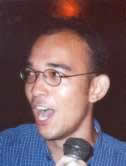 |
| Participating in karaoke is essential to integration in the Philippines |
It has been a few years since I was in the Philippines (I returned to Canada in August, 2001), but I still remember the farmers we worked with who faced huge obstacles in terms of lack of resources and support. Mostly I remember the personal connections I made; the farmer's generosity; the sense of community that we are largely lacking in Canada; the selflessness of rural Filipinos to help each other out.
I still keep a photo on my office wall of a forest I visited in the uplands of Southern Negros, and although I am no longer involved in any of REAP-Canada's Philippine endeavors, I often think of the farmers I met and befriended. Near Tabugon, a farmer named Nong Imoy lived with his family on an area that was difficult to farm conventionally due to the infertility of the soil and the slope of the land. Historically, his father had cleared the forest and had planted corn for a number of years, but this was not a very sustainable practice. Nong Imoy made ends meet by planting the area with gmelina trees for lumber and had planted some coffee plants, as well as raising a number of goats and keeping a small garden. On his property, there were some caves that extended for kilometers under the ground that we explored during Easter break. Also in the uplands near Candoni, a farmer named Nong Caso farmed rice, kamote and sugarcane right on the edge of a forest. Just to get to Nong Caso's house was a fantastic journey, since the road to his house was too muddy to drive except by motorcycle in the rainy season. Our flip
Flops would get stuck in the mud and so we had to walk barefoot for long stretches (unfortunately my feet were not very tough). Caso and Imoy carried themselves with a real sense of peace. Their connection with the land and their willingness to help out their neighbours provided them with a grounding that I wish more of us could have in our day-to-day lives here in Canada.
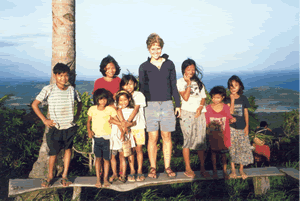
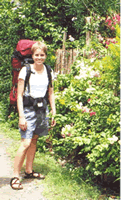
Lindsey Mulkins, Intern 2000-2001
Background Bio:
Through my educational and professional experiences, I have developed an interest in promoting ecological and community health through education, community development, and design. My university studies have covered the broad fields of biology, environmental education, and sustainable cities. My current interest rests in the area of community engagement in the stewardship of urban natural areas.Host Country:
the PhilippinesEducation:
B.Sc. (Environmental Science, honors), Queens UniversityM.Sc. (Environmental Studies), York University
Internship Experience:
I was fortunate to participate in a range of enriching experiences while I was in the Philippines. I worked with farmers and community organizers on a daily basis, promoting more sustainable approaches to food production. One focus of my work was encouraging farmers to diversify the crops they grew away from the monoculture of sugarcane, towards a model of greater food security, including rice, corn, and a range of vegetables. I also helped to promote the concept of the self-sufficient and sustainable "Agro-Ecological village," an idea that has helped to shape some of my more current work in Canadian cities. Coupled with this first-hand learning, the skills that I gained while on my internship, including cross-cultural sensitivity, effective communication strategies, self-motivation, and project conceptualization, have helped me immensely in the years since my Filipino experience. All in all, it was a deeply enriching and rewarding experience, and the lessons that I learned have positively influenced my life in innumerable ways.