



Mayon Turbo Stove: Introduction
Fueling the fight against poverty
|
MENU MTS Evolution MTS Design Package Phillippine Case Study Gambia Case Study Carbon Credits Online library |
The mountains of surplus rice hulls found throughout South and Southeast Asia and other developing regions can now be used as an alternative, convenient and low cost cooking fuel in the Mayon Turbo Stove (MTS). Given that rice is the number one food crop in the world and is produced in many developing nations where households rely on firewood, charcoal and LPG for fuel, the MTS has the potential to reduce cooking costs, slow deforestation, improve air quality and reduce GHG emissions of rural communities around the world.
| Video Clips | |
 |
Windows Media (3.8 MB) |
 |
Quicktime Movie (5.5 MB) Windows Media (2.1 MB) |
 |
Quicktime Movie (5.3 MB) Windows Media (1.8 MB) |
Household cooking is one of the most important energy issues today and has a major impact on human health and the landscape ecology of developing nations. The vast majority of rural households in developing countries still rely on traditional biofuels for cooking, including firewood, charcoal, and crop residues such as cereal straws, corn cobs, and coconut husks and shells. The incomplete combustion of biomass can produce pollution levels in the home exceeding that of the most polluted industrial cities. Fossil fuels, like LPG and kerosene, are also used in the home, however they are increasingly unaffordable for impoverished families.
As the population grows and more land in tropical forests is converted into agricultural use, rural villagers are beginning to rely more heavily on agricultural residues for fuel. For these reasons, the development of a convenient low cost cooking system using crop residues produced in a sustainable manner is of great consequence to many developing nations.
 |
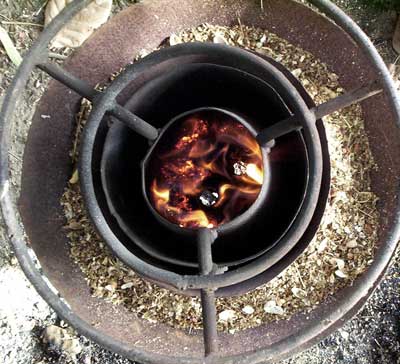 |
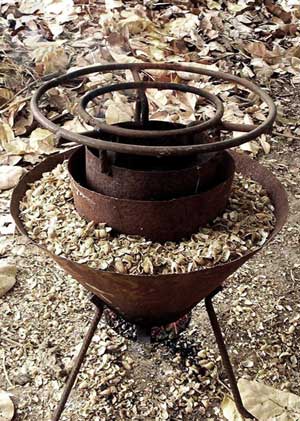
| The Mayon Turbo Stove is a multi-fuel stove that can also burn peanut shell and millet husk mixtures | An above view showing the clean combustion of the new Mayon Turbo Rice Hull cooker |
Order your MTS International Marketing and Manufacturing Package Today!
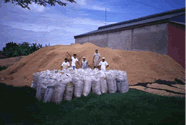 |
There are more than 1.5 million tonnes of rice hulls in the Philippines, which could be used as cooking fuel by more than 1 million families |
Inspired by the Mayon volcano, the MTS stove has a 'perfect' cone design that allows the clean, efficient, and convenient combustion of crop residues produced by milling the world's most important food crop. Low-income rural families can now utilize surplus rice hulls found throughout much of the developing world as a clean burning and low cost cooking fuel alternative. For $15-$20 USD per cooker, impoverished families are gaining access to this new stove to reduce their household cooking expenses and to improve indoor air quality. Over the past few years, 5,000 rice hull stoves have been distributed in Philippines by REAP-Canada and their local partners. REAP is now stepping up efforts to introduce this simple technology internationally. There is a pressing need to improve the extreme conditions faced by the millions of rural poor in the world.
Featuresof the Stove
- High efficiency and clean combustion: high quality, swirling blue flames are created from the twin primary air injectors and the extended inner cone with secondary air holes
- Economical: Average annual cooking costs and stove purchase is approximately $15-20 USD for the MTS, compared to $60-200 USD for cooking with purchased firewood, charcoal and LPG
- Fast boiling: 1 litre of water can boil in 6-7 minutes
- Convenient to use: tapping to introduce new fuel is required approximately only every 7-10 minutes
- Low fuel consumption: Approximately 2.5 sacks (25 kg) of rice hull/family/week
- Portable and lightweight: steel construction, weighing approximately 4 kg; can be used both indoors and outdoors
- Uses a variety of biofuels: Enables the use of many fuels to be used in conjunction with rice hull including corn cobs, peanut shells, cocoa shells, crushed coconut shells, millet husk, and sawdust
- Safety: a ring structured holder provides excellent pot stability
- Holistic Use of Fuel: ashes can be reused as a soil conditioner, fertilizer, and pest repellent around plants
By utilizing agricultural residues, the MTS reduces the following:
- the amount of firewood, charcoal and LPG burned
- household expenditures
- greenhouse gas emissions
- the firewoosd-collecting burden on women
- household air pollution
- deforestation rates
| Presentation | |
| Click here to view a powerpoint presentation on the Mayon Turbo Stove! |  |
Learn more about:
- MTS Evolution
- Purchasing an MTS Design Package
- MTS in the Philippines
- MTS in the Gambia
- Carbon Credits


