


REAP's Achievements
Since 1986, REAP has worked both in Canada and abroad promoting environmentally sound sustainable development with ecological solutions. Milestones achieved over the years have made us excel in our programming and be recognized as world leaders in agrarian community development.
Achievements attained with the support of our program partners and donors include:
| Perennial
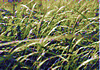
Grasses for Bio-Fuel Pellets/Briquettes. Commercializing renewable biofuel crops is an attractive alternative to enhance energy security and mitigate global warming. REAP-Canada has pioneered the development of biofuel pellets made from switchgrass (Panicum virgatum), a perennial grass native to the North American prairies. This grass has a remarkably high net energy yield, low cost of production, and a net energy yield per hectare double that of corn. |
 |
Development
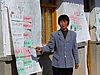
of the Agro-Ecological Village Model. REAP-Canada has developed the Agro-Ecological Village (AEV) Model to support rural communities through the creation of self reliant, integrated and ecological food and energy systems. This model promotes holistic, participatory development while simultaneously addressing social development, gender equity, poverty mitigation, agriculture and the environment. The model has been successfully implemented by REAP-Canada and its partners in the Philippines, China, and the Gambia. |
 |
Development
of the Mayon Turbo Stove. Other available rice hull stoves have suffered from one or more deficiencies including incomplete combustion, excessive air, uncontrollable fuelbed fires, high rice hull consumption, constant need for tending, and high production costs. Through an intensive research and development program with local community partners and technical workshops, several innovations were made. The Mayon Turbo Stove (MTS) allows higher combustion efficiencies and produces a smokeless blue flame at the low cost of $10 USD per stove. The MTS has been distributed to over 5000 households in the Philippines and is currently being introduced to rural communities in the Gambia. Developments are currently underway to introduce the stove to other countries. |
 |
Greenhouse Gas Mitigation in Developing
Countries. The Canadian Environmental Network - International Program (CEN-IP) presented the International Environment Award to REAP-Canada for their Philippine programming activities. CIDA support has included the Philippine Agricultural Climate Change Project. This program promoted the efficient use of crop residues for both nutrient conservation and cooking fuels as part of a strategy to reduce harmful emissions and local air pollution. The introduction of ecological sugarcane farming and the Mayon Turbo Rice Hull Stove to rural communities enabled the mitigation of 4240 tonnes of CO2e over the period of one year. REAP-Canada is presently developing a large biofuel project in China to displace 10% of China's coal use. |

